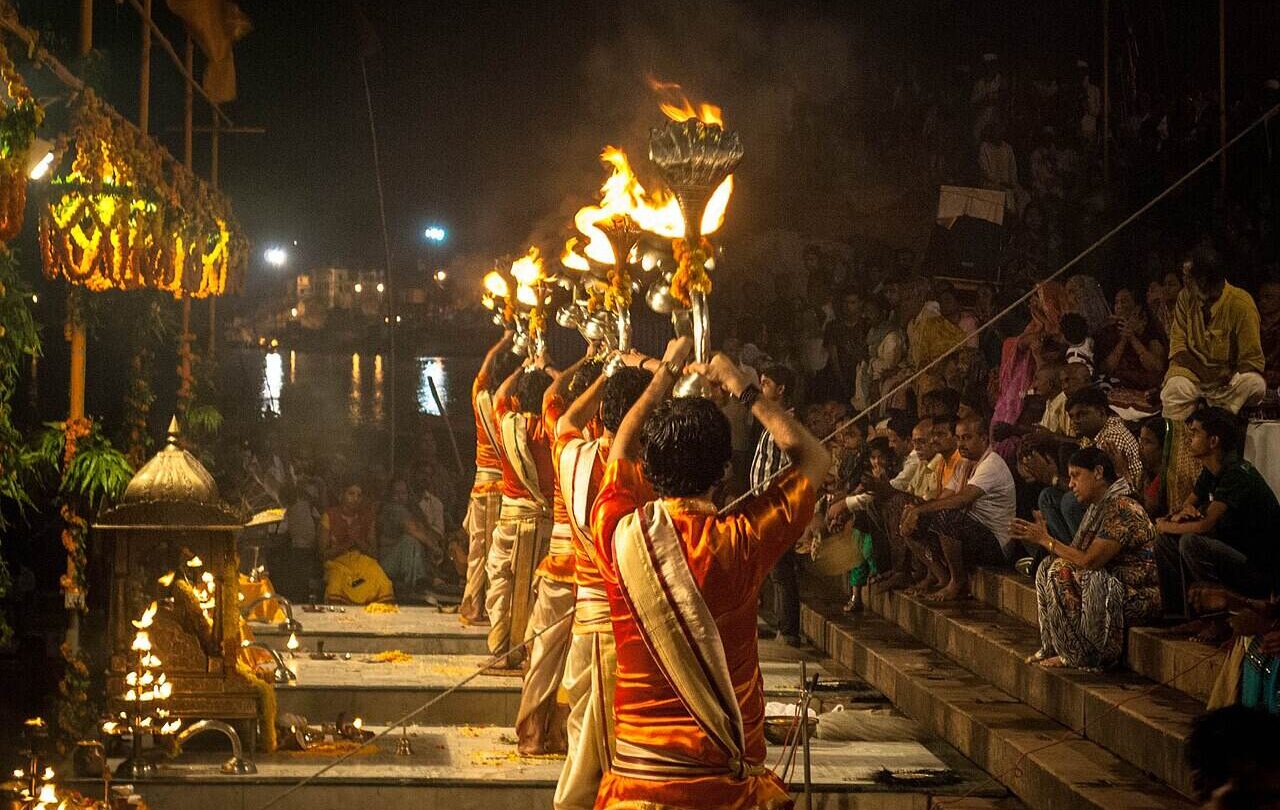
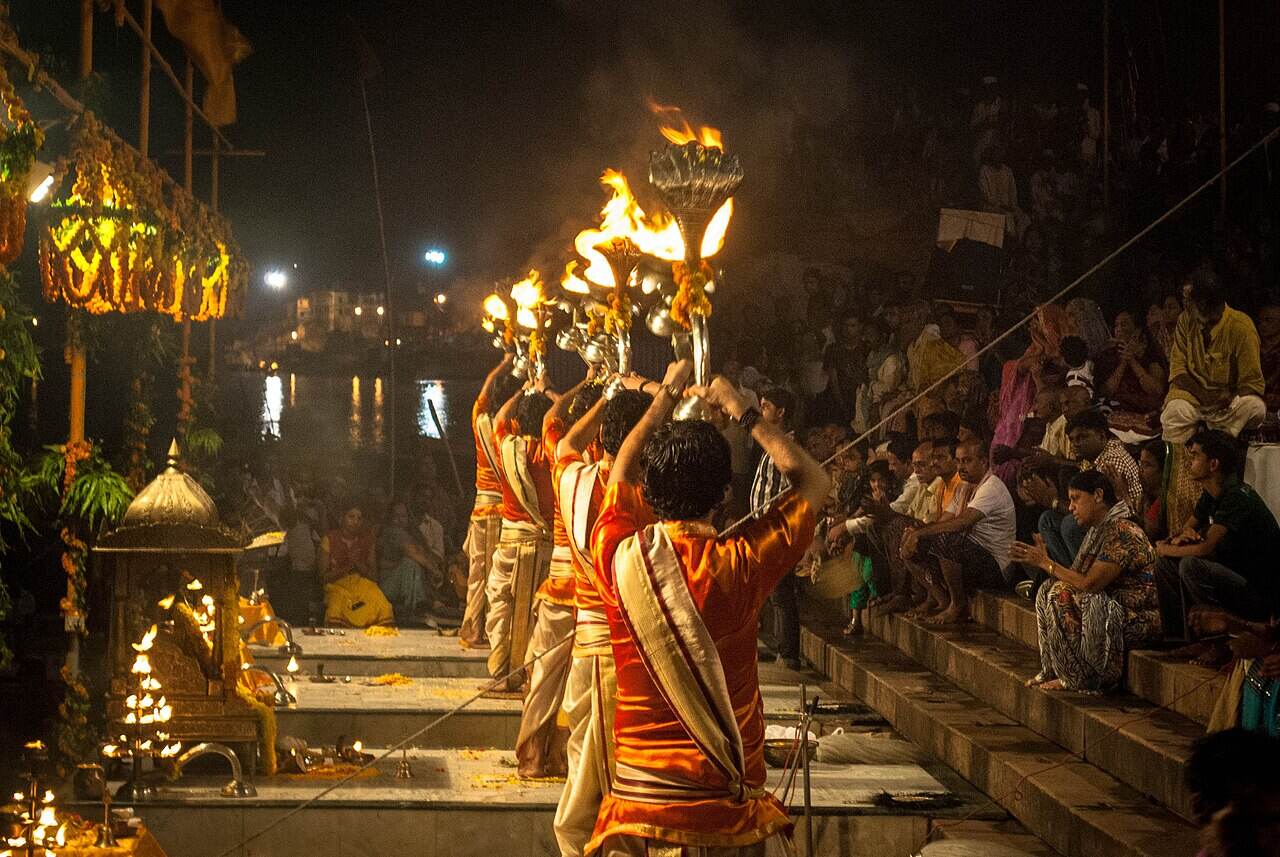
Evening Ganga aarti at Dashashwamedh Ghat. Photo: Sujay25, CC BY-SA 4.0, via Wikimedia Commons
Last updated: 28 October 2026 by the indiatourblog.com editorial team. We checked every fact below against the sources listed at the end.
Quick answer: The main Ganga aarti happens every evening at Dashashwamedh Ghat. It starts soon after sunset and lasts about 45 minutes. Arrive an hour early. Watch from a boat for the wide view, or from the steps for the sound and heat of the lamps. Do a sunrise boat ride too, from Assi Ghat. Agree on every price before you start.
Varanasi (also called Banaras or Kashi) sits on the Ganges river in Uttar Pradesh. Its riverfront has 84 stone steps called ghats. Most first-time visitors want two things: the evening fire ceremony and a boat ride. This guide helps you plan both, pick the right spot, and avoid the usual price games. It is part of our Varanasi travel guide.
What is the Ganga aarti, and where does it happen?
An aarti is a Hindu worship ritual where priests wave lit lamps in front of a deity. In Varanasi the deity is the river Ganga. The best-known aarti is at Dashashwamedh Ghat, close to the Kashi Vishwanath temple area.
India’s tourism site Incredible India describes the ritual as a 45-minute ceremony at dusk with conch shells, bells, cymbals, chanting and lamps. Priests stand on raised wooden platforms, and the head priest of the Gangotri Seva Samiti leads the rites. Wikipedia adds that the ghat also holds special aartis on Tuesdays and on religious festivals.
Other ghats hold smaller aartis. The big one at Dashashwamedh is the one people mean when they say “the Ganga aarti”.
What time does the Ganga aarti start?
It starts soon after sunset, so the time moves with the seasons. Wikipedia gives about 7 PM in summer and 6 PM in winter. Two travel sites that publish 2026 tables, Varanasi Guru and GoWithGuide, give 5:45 PM from October to March and 6:45 PM from April to September. Neither is an official source, so treat the minute as a guide.
| Months | Evening aarti (Dashashwamedh) | When to arrive |
|---|---|---|
| October to March | About 5:45 to 6:00 PM | 4:45 PM on weekdays; 4:15 PM on weekends and holidays |
| April to September | About 6:45 to 7:00 PM | 5:45 PM on weekdays; 5:15 PM on weekends and holidays |
GoWithGuide advises 45 to 60 minutes early on weekdays and 75 to 90 minutes early on weekends and holidays. That matches what we would plan for. Ask your hotel for today’s exact time when you check in.
Should you watch from a boat or from the ghat steps?
Pick the boat if you want a clear view and space to breathe. Pick the steps if you want to be close to the sound. Here is how they compare.
| Boat | Ghat steps | |
|---|---|---|
| View | Wide, from the water, slightly from the side | Close, but only in the first few rows |
| Crowd | Boats pack together, but you have your own seat | Very tight at the front |
| Cost | Paid (see the price table below) | Free |
| Arrive | About 30 to 45 minutes before the start | At least an hour before |
| Skip it if | You get seasick, or the river is high | You dislike crowds or standing still for an hour |
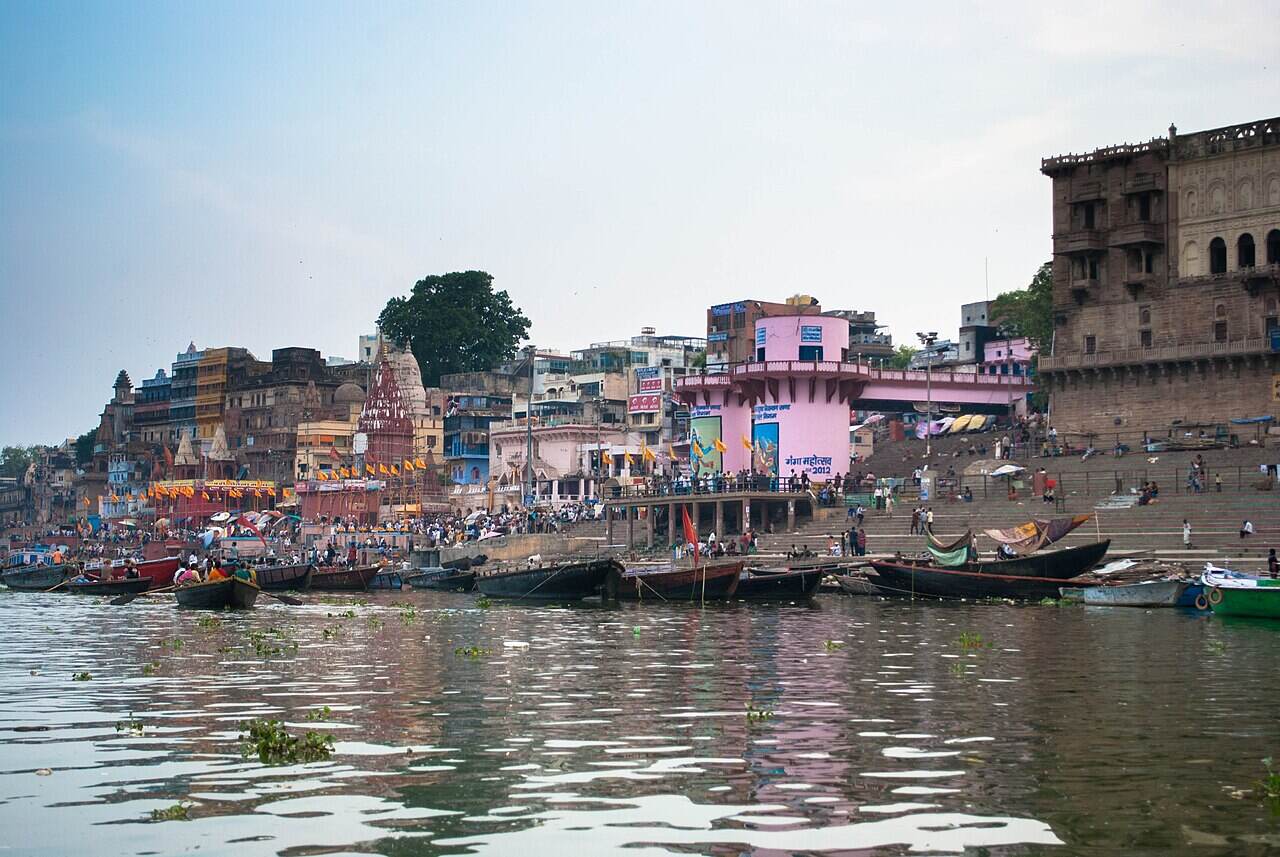
One travel hotel blog, Amritara, says the boat should sit about 30 metres from the ghat and that front rows on the steps go early. Some places also set up chairs or balcony seats near the ghat and charge for them. GoWithGuide lists a charge of 100 to 200 rupees for seats that look free. If a seat is not clearly free, ask the price first.
You cannot do both at once. A good plan is the steps on your first evening and a boat on another night, if you have two evenings.
How much does a boat ride in Varanasi cost?
There is no one official price for tourist boats, and the numbers online do not agree. We found these figures, all from travel sources and none from the city:
| Ride | Reported price | Source |
|---|---|---|
| Shared seat, sunrise | 80 to 150 rupees per person | GoWithGuide, 2026 |
| Shared seat, aarti time | 200 to 300 rupees per person | GoWithGuide, 2026 |
| Private rowing boat | About 400 rupees per hour | GoWithGuide, 2026 |
| Private boat for 2 to 4 people, aarti time | 600 to 1,200 rupees | Amritara hotel blog |
| Large motor or wooden boat, peak time | Over 4,000 rupees | GoWithGuide, 2026 |
The Hindu reported a fixed boat fare of 345 rupees between Assi and Namo ghats, and more than 1,000 rupees for a cruise ride. That article does not show a date, so check it locally. It also says about 1,300 boats and 5,000 boatmen work across the city’s 84 ghats, so boats are easy to find.
The gaps are huge. One blogger was first quoted 1,000 rupees and paid 700, then wrote that a fair price was nearer 120. We cannot tell you which figure is right today. What we can say is that the first price you hear is usually high.
- Ask your hotel what a normal price is for your day and time.
- Say how many people are in your group, and how long you want to ride.
- Agree on the total, in rupees, before you step in.
- Pay at the end, not at the start. Carry small notes (see how to pay in India).
- Do not get into a rowing boat that holds more than 6 people. Adventurous Miriam, a travel blog, flags this as unsafe.
A tip for the boatman is normal but not a must. Our tipping in India guide has the usual amounts.
What is a sunrise boat ride like?
A sunrise ride is quieter and cheaper than the evening one. Most trips start at Assi Ghat, the southernmost ghat, where the Assi stream meets the Ganges. The boat drifts north past the ghats. Amritara lists the order as Tulsi, Harishchandra, Dashashwamedh, Manikarnika and Man Mandir.
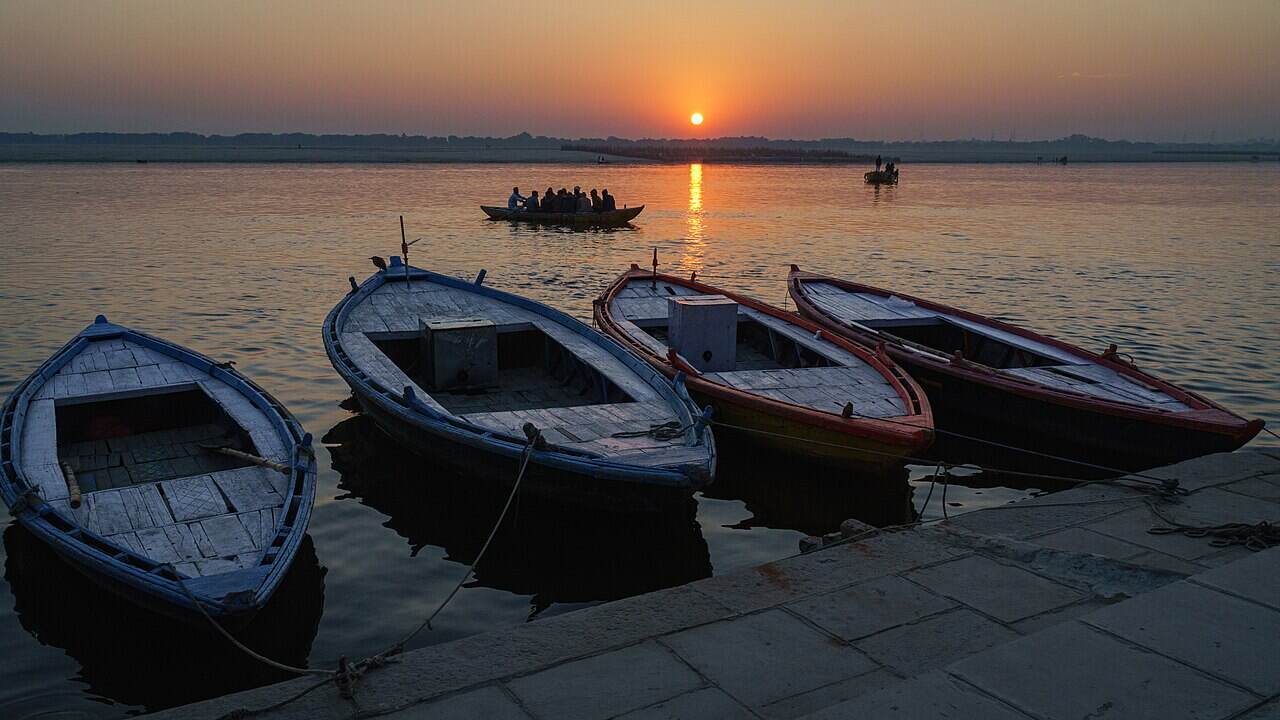
Harishchandra and Manikarnika are cremation ghats. Cremations take place there. Stay quiet, do not point your camera at the pyres, and keep your distance. SOTC, an Indian travel company, says photographing cremations at Manikarnika is not acceptable.
Plan on 90 to 120 minutes. Pack a warm layer for winter mornings, long trousers and mosquito spray. Mosquitoes are worst at dawn and dusk, says Adventurous Miriam.
What is Subah-e-Banaras at Assi Ghat?
Subah-e-Banaras means “Banaras morning”. It is a free early-morning program at Assi Ghat that started on 24 November 2014. The official site says it includes Vedic chanting, a morning aarti, a fire ritual, classical music and yoga.
The site gives these times:
- Summer: 4:50 AM to 7:00 AM
- Winter: 5:40 AM to 7:45 AM
It runs about two hours. You can combine it with a sunrise boat ride: watch the first hour on the steps, then walk down to the water. SOTC calls Assi the calmer choice for a morning visit.
Do boats and the aarti stop during floods?
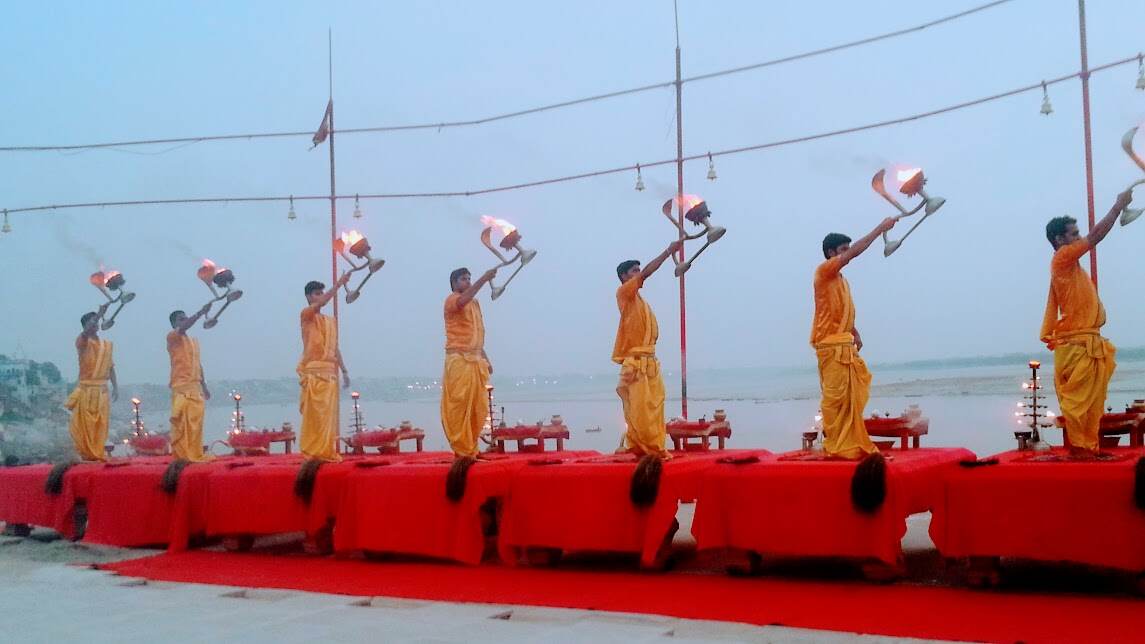
Yes, they can. The Ganga rises during the monsoon, usually from July to September. The Central Water Commission sets the danger level at Varanasi at 71.262 metres. ThePrint reported on 4 August 2025 that the river stood at 72.1 metres, officials banned boats, and the Dashashwamedh aarti moved to rooftops.
It happened again in 2026. PTI, via Siasat, reported on 2 September 2026 that the river had crossed the warning mark of 70.26 metres and officials had suspended all boat operations.
If you travel from July to September, keep a plan B. Watch the aarti from a rooftop restaurant or from the upper steps, and book boats only with a refund option. Our best time to visit India checker can help you pick dates. The cooler months from November to February are the easiest for boats and walking.
What about Dev Deepawali on 24 November 2026?
Dev Deepawali, the “festival of lights of the gods”, falls on Tuesday, 24 November 2026, which is Kartik Purnima (the full moon of the month of Kartik). Lamps light up every ghat from Assi to Rajghat at dusk.
It is the most crowded night of the year. A cab operator’s page says boat prices on the night run several times the normal aarti rate, and that good boats are gone by early November. It also says roads into the ghat zone close from early afternoon. That page is commercial, so ask your hotel to confirm. If you want to go, book a boat and a hotel near the ghats now. Read our India festival calendar for other dates, and our Diwali 2026 guide for what closes around that time.
What common tricks should you watch for?
Most people you meet will be friendly. A few tricks come up often in travel guides:
- The free tilak. Someone puts a mark on your forehead, then asks for 100 to 500 rupees (GoWithGuide). Say “no, thank you” and keep your hands down.
- The “official” guide. People near the temple lanes may claim to be officials and lead you through side alleys for a fee.
- Blessing after the ritual. A priest does a short rite, then asks for a large sum. Agree on the amount before any ritual or offering.
- Pickpockets. Crowds at the aarti are the main risk. Wear your bag in front.
The rest of the safety picture is in our India safety guide. For food near the ghats, see street food safety. For temple dress rules, see what to wear in India.
Sample plan for two nights in Varanasi
- Day 1, late afternoon: Walk to Dashashwamedh Ghat. Be on the steps by 4:45 PM in winter or 5:45 PM in summer. Watch the aarti from the steps.
- Day 2, before sunrise: Go to Assi Ghat for Subah-e-Banaras. Take a shared or private boat north at first light.
- Day 2, evening: Take a boat for the aarti, booked through your hotel. Leave about 45 minutes before the start.
If you have one night only, do the sunrise boat and skip the aarti boat. You will see more of the ghats in daylight. Arriving by train? See how foreigners book trains in India. For getting around the old city, see taxis and drivers in India.
Frequently asked questions
What time is the Ganga aarti in Varanasi?
The evening aarti at Dashashwamedh Ghat starts soon after sunset and lasts about 45 minutes. Expect about 5:45 to 6:00 PM from October to March and about 6:45 to 7:00 PM from April to September. Confirm the time with your hotel on the day.
Is the Ganga aarti free to watch?
Yes. Standing or sitting on the ghat steps is free. You only pay if you take a boat, a balcony seat or a chair that someone sets up for a fee. The morning Subah-e-Banaras program at Assi Ghat is also free.
How much does a boat ride in Varanasi cost?
There is no single official rate for tourist boats. Sources quote anywhere from about 80 to 300 rupees for a shared seat and from about 400 to over 4,000 rupees for a private boat, depending on boat size, time and season. Agree on the price and the number of people before you step in.
Should I watch the aarti from a boat or from the ghat?
A boat gives a wider view and more space, but you see the priests from the side and from a distance. The steps put you closer to the sound and the heat of the lamps, but you must arrive early to get a spot. If you can only pick one, pick the boat for the view and the steps for the feeling.
Are boats stopped during the monsoon?
Yes, they can be. When the Ganga rises above the warning and danger marks, officials suspend boat operations. This happened in August 2025 and again in September 2026. The Central Water Commission lists the danger level at Varanasi as 71.262 metres.
Is the Ganga aarti safe for solo travellers and women?
The ghats are crowded and well lit during the aarti, and many solo travellers go. Keep your bag zipped in front of you, avoid the narrow lanes alone late at night, and book your boat through your hotel. Pickpocketing and overcharging are the main risks.
When is Dev Deepawali in 2026?
Dev Deepawali falls on Tuesday, 24 November 2026, on Kartik Purnima. Every ghat is lit with lamps at dusk. Boats cost several times the normal rate that night and sell out weeks ahead.
Sources
- Incredible India (Ministry of Tourism): Dashashwamedh Ghat
- Wikipedia: Dashashwamedh Ghat
- Wikipedia: Assi Ghat
- Subah-e-Banaras: About
- ThePrint, 4 August 2025: Ganga crosses danger mark in Varanasi
- Siasat / PTI, 2 September 2026: Ganga crosses warning mark in Varanasi
- The Hindu via inkl: Varanasi’s traditional boatmen and the water taxi plan
- GoWithGuide (commercial), updated 19 August 2026
- Varanasi Guru (commercial): aarti timing 2026
- Amritara hotel blog: Ganga aarti guide
- Adventurous Miriam: Varanasi boat ride
- SOTC: Ganga aarti travel tips
- Triveni Cabs (commercial): Dev Deepawali 2026
Image credits: Sujay25 (CC BY-SA 4.0), Schwiki (CC BY-SA 4.0) and Titodutta (CC0), all via Wikimedia Commons. Read how we work in our editorial policy. Prices and times change, so confirm locally.